DELIA Sticks Explained: How Smartcore Engineering Simplifies the Everyday Heated-Tobacco Experience
The most interesting part of DELIA is hidden inside the stick rather than on the packaging. Designed specifically for IQOS ILUMA, DELIA uses the platform’s SMARTCORE™ induction technology to heat tobacco without relying on the exposed blade found in earlier generations. For consumers comparing newer and legacy systems, стики DELIA represent a meaningful shift in the relationship between consumable and device. The stick is no longer simply a tobacco-filled accessory: its internal construction is engineered around the heating system itself. Official IQOS specifications describe DELIA as an ILUMA-compatible heated-tobacco range with an internal metal heating element, carefully prepared tobacco, and an airflow chamber designed to support a controlled draw.
That integrated approach is what makes DELIA particularly interesting from a consumer-electronics perspective. The device supplies the induction energy, while the stick contains the component that interacts with the electromagnetic field. Instead of repeatedly inserting a heating blade into tobacco, the user interacts with a sealed, purpose-built consumable. The result is a workflow designed to reduce mechanical contact, simplify routine upkeep, and deliver a more standardized heating process from one session to the next.
The Metal Core That Turns the Stick Into Part of the Hardware
At the heart of DELIA is an innovative metal heating element positioned inside the tobacco stick. IQOS describes this element as being coated with stainless steel and located within the tobacco section so that induction heating can take place from inside the consumable. When the stick is inserted into an ILUMA device, the electromagnetic field interacts with the metal component and transfers heat to the surrounding tobacco.
This arrangement is fundamentally different from a blade-based heating architecture. The device no longer needs to push a hot metal blade directly into the tobacco plug. Instead, the heating mechanism is effectively distributed between two coordinated components: the electronics and induction coil remain in the holder, while the metal heating element is built into the disposable stick.
A Blade-Free Design Removes One of the Most Annoying Maintenance Tasks
For regular users, the most noticeable benefit may be the reduction in maintenance rather than the underlying electromagnetic engineering. Earlier blade systems could accumulate tobacco residue around the heating area and required periodic cleaning. DELIA’s sealed internal construction is designed to minimize that problem because the heating element does not remain exposed inside the holder.
- The heating element is contained within the DELIA stick rather than exposed in the holder.
- The tobacco section is designed as part of a sealed consumable structure.
- Reduced direct contact between tobacco and the device simplifies everyday maintenance.
- There is no exposed heating blade to clean after repeated sessions.
- The basic routine becomes insertion, automated heating, use, removal, and disposal.
This should not be interpreted as meaning that an ILUMA device never needs care. Exterior cleaning, charging contacts, storage, and general handling still matter. The meaningful difference is that one of the repetitive maintenance routines associated with blade-based hardware becomes dramatically less demanding. IQOS specifically presents the blade-free architecture as a way to avoid the tobacco residue associated with previous generations.
Fewer Exposed Parts Also Change the Reliability Equation
A physical blade creates an additional mechanical vulnerability because it repeatedly enters and exits the tobacco stick. Incorrect insertion, residue accumulation, or accidental contact can potentially affect such a component. DELIA’s induction architecture removes that exposed blade from the holder entirely.
From an engineering standpoint, this is a sensible structural simplification. The holder does not need a narrow heating element to physically penetrate the tobacco plug, while the disposable stick carries the metal component required for induction. The design consequently reduces the number of delicate heating components directly exposed to everyday handling.
It is important to distinguish this architectural advantage from a guarantee of unlimited durability. Any electronic device can be damaged through drops, moisture, incorrect charging, or inappropriate use. The benefit here is more specific: eliminating the exposed blade removes one category of mechanical interaction that existed in legacy IQOS designs.
Compatibility Is Deliberately Narrower Because the Engineering Is More Specialized
DELIA sticks are designed exclusively for IQOS ILUMA-compatible devices, including the ILUMA and ILUMA i families. They are not intended for earlier blade-based IQOS generations. Official guidance explicitly warns against using DELIA with older devices because the heating architecture is fundamentally different.
This limitation is not simply a marketing decision. The internal metal component is necessary for induction heating, so the consumable must be designed around the electromagnetic system. In practical terms, consumers should regard the device and stick as one engineered ecosystem rather than assuming that different generations of heated-tobacco products are interchangeable.
Inside DELIA, Airflow Engineering Helps Shape the Sensory Delivery
The heating element is only one part of the internal structure. Official product information identifies several additional components, including a front seal, tobacco section, and airflow chamber. The airflow chamber is designed to control the amount of aerosol passing through the stick, helping produce an easier and more consistent draw.
This is important from a flavor-analysis perspective because perceived quality depends on more than the tobacco blend itself. Temperature, aerosol volume, airflow resistance, and cooling all influence how aromatic compounds are experienced. A carefully controlled internal pathway gives the manufacturer additional variables with which to shape the final sensory profile.
The resulting experience is therefore better understood as a combination of tobacco formulation and mechanical delivery. Two sticks can contain different blends while relying on the same underlying architecture to produce a controlled heating and airflow process.
DELIA Concentrates on Familiar Tobacco Profiles Rather Than Maximum Flavor Complexity
Where some heated-tobacco ranges emphasize elaborate combinations of fruit, cooling, and capsule effects, DELIA is positioned around recognizable tobacco-oriented profiles. Official IQOS descriptions identify classic variants with distinct aromatic directions, including malty, nutty, and cooling characteristics.
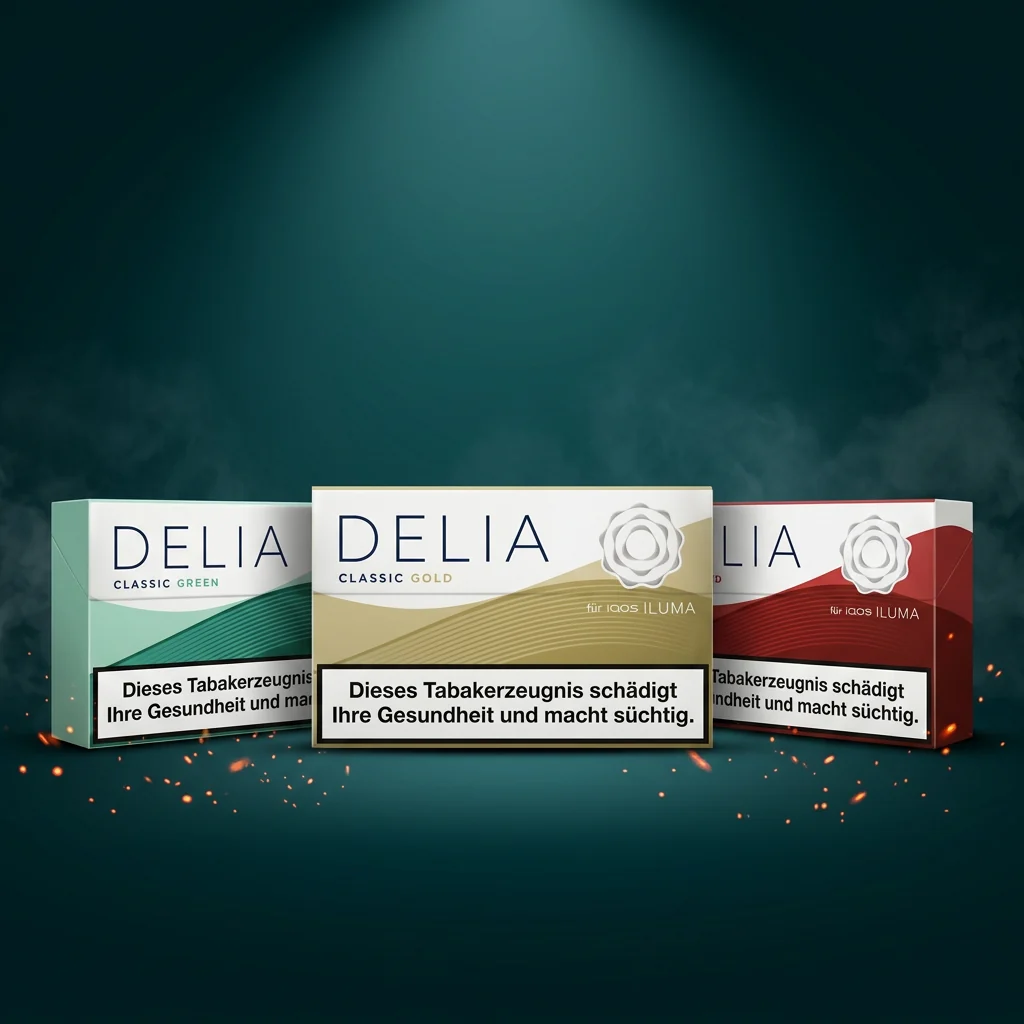
- DELIA Classic Red uses a full-bodied toasted tobacco blend with malty aromatic notes.
- DELIA Classic Gold combines mellow, aromatic tobacco with nutty nuances.
- DELIA Classic Dark Green emphasizes mellow tobacco with a pronounced menthol cooling note.
Availability and the exact portfolio can differ between markets, so these profiles should be treated as representative examples rather than a universal list. Official IQOS information also shows that other markets can offer additional DELIA variants, including versions with different cooling or berry-oriented aromatic characteristics.
The Flavor Strategy Is Built Around Familiarity and Balance
DELIA’s flavor concept is particularly relevant for consumers who prefer the recognizable character of traditional tobacco rather than highly layered aromatic combinations. Classic Red emphasizes depth and toasted notes, making it the more robust direction of the three widely documented profiles. Classic Gold moves toward a softer, more aromatic tobacco character with nutty nuances. Dark Green changes the experience through cooling, creating a sharper and fresher finish.
These descriptions should not be treated as universal sensory measurements. Perception depends on individual taste sensitivity, draw behavior, storage conditions, and personal expectations. Nevertheless, the formulation strategy is clear: DELIA provides a relatively straightforward sensory vocabulary while leaving the ILUMA hardware to handle the technical consistency of heating and airflow.
A Significantly Reduced Aroma Footprint Comes From Heating Rather Than Burning
DELIA is a heated-tobacco product, not a conventional cigarette. The tobacco is heated without combustion, meaning there is no burning process that produces ash and conventional cigarette smoke. IQOS states that this results in significantly less lingering smell compared with traditional smoking, although the product still produces tobacco-containing aerosol and should not be described as odorless.
For everyday environments, this distinction can be meaningful. The surrounding aroma is generally less persistent than cigarette smoke, while the selected DELIA profile can influence the character of what is perceived. Ventilation, room size, fabrics, and individual sensitivity still affect the result, so a reduced aroma footprint should be understood as a practical comparison rather than an absolute promise.
The Session Is Designed Around Predictability Instead of Mechanical Interaction
Official instructions describe a straightforward operating sequence: insert the DELIA stick into a compatible ILUMA device, activate the system, wait for the readiness signal, use the stick, and remove it after the session. A DELIA stick is designed to provide up to 14 puffs or up to six minutes, whichever comes first, although actual duration can vary according to individual usage patterns.
This predictable sequence is one of the strongest lifestyle advantages of the platform. There is no need to manipulate an exposed heating blade, and the device handles the thermal process electronically. For frequent users, eliminating those small mechanical steps can make the entire routine feel noticeably more streamlined.
The Real Upgrade Is the Reduction of Everyday Friction
DELIA is most interesting when viewed as part of the broader ILUMA engineering strategy rather than as an isolated tobacco product. The internal metal heating element supports induction heating. The sealed construction reduces direct tobacco contact with the holder. The airflow chamber contributes to controlled aerosol delivery. The absence of a physical blade simplifies maintenance and removes one of the more delicate components of older systems.
There are still important considerations. DELIA contains nicotine, which is addictive, and heated-tobacco products are not risk-free. The sticks are also designed for a specific hardware ecosystem and should not be used with incompatible devices. Official guidance additionally warns users not to ingest or disassemble the sticks because of the internal metal component.
From a consumer-electronics perspective, however, the architecture is coherent. DELIA does not rely on a single flashy specification to distinguish itself. Its advantages come from several smaller engineering decisions working together: induction instead of blade heating, a metal element integrated into the consumable, controlled airflow, purpose-built tobacco formulations, and a sealed structure designed to reduce residue. For adult users who have already selected the heated-tobacco category, that combination produces a simpler ownership routine, fewer mechanical maintenance concerns, and a more consistent sensory delivery than the blade-based workflow associated with earlier generations.